Showing posts with label Childrens Bible Stories. Show all posts

Tuesday, July 31, 2012

Childrens Bible Story of Cain and Abel


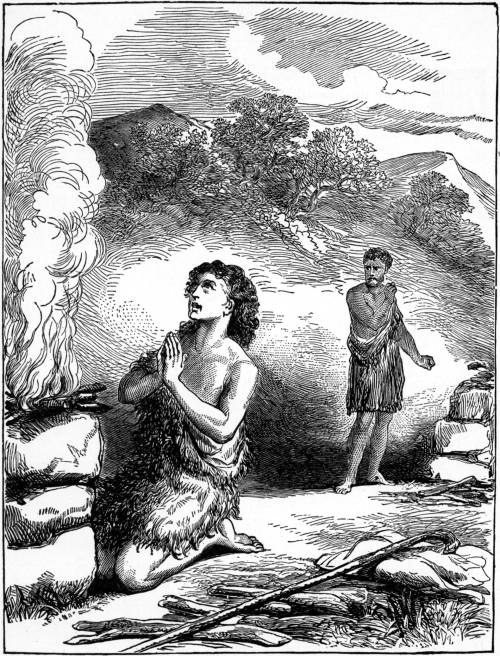
CAIN AND ABEL.


What a sad story the Bible tells us in the fourth chapter of Genesis! Cain and Abel were brothers, the sons of Adam and Eve. How they should have loved each other! Yet we find that Cain killed Abel. Why did he do this?
Cain was a husbandman, who tilled the ground; Abel was a shepherd, who kept sheep. One day each offered a sacrifice to God. Cain brought fruit, and Abel brought a lamb. God accepted Abel's offering, but not Cain's. Why? Well, I am not quite sure, but I think it was because Abel offered his sacrifice according as God had commanded, and had faith in a promised Saviour; but Cain simply acknowledged God's goodness in giving him the fruits of the earth. God had probably told them, too, that when they came to worship Him, they were to bring a lamb or a kid as a sacrifice for their sins; this Abel had done, but Cain had not. Cain was angry because God had accepted Abel's offering and not his; and he hated his brother Abel.
God knew the evil thought Cain had towards his brother, and asked him, "Why art thou wroth?" and said, "If thou doest well, shalt thou not be accepted?" But Cain did still more wickedly. When out in the field he killed his brother. Was it not a cruel deed? They were alone when this murder was committed, yet one eye saw it all. God saw it, and said to Cain: "Where is Abel, thy brother?" We cannot sin without God knowing it! Cain told God a lie. He answered, "I know not." But he did know. God was angry with Cain for his sin, and sent him as a fugitive and vagabond to wander on the earth.


ABEL'S SACRIFICE.
ABEL'S SACRIFICE.

Childrens Bible Story of Abraham and Issac


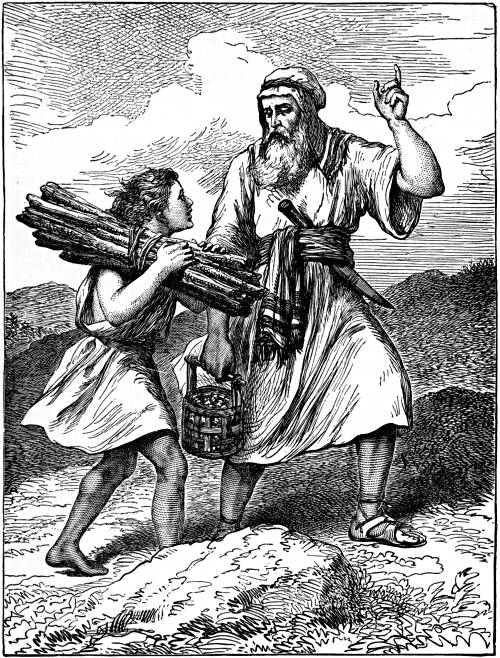
ABRAHAM AND ISAAC.ToC


Abraham feared God and obeyed His commandments; and God promised to bless Abraham very greatly. He gave him riches in cattle, and silver, and gold; and said that the land of Canaan should belong to him and his descendants. God also gave him a son in his old age, whom he loved, very dearly and named Isaac. But God intended to try Abraham, to see if he loved Him above all else.
One day God told Abraham to take his son Isaac, and to journey into the land of Moriah; there to build an altar and offer Isaac as a sacrifice upon it. It was a strange command, but Abraham knew that God would not bid him do what was wrong, and believed that even if he slew his son, God was able to raise him to life again. So he rose early in the morning, saddled his ass, took two of his young men, and wood for the fire; and then, accompanied by Isaac, started on his journey. On the third day they came near the place God had pointed out, and Abraham left the young men with the ass, while he and his son journeyed up the mountain alone. As they went along, Isaac—who carried the wood, while his father carried the knife and the fire, said: "My father." And Abraham replied, "Here am I, my son." Then Isaac said: "Behold the fire and the wood: but where is the lamb for a burnt offering?" Abraham answered: "My son, God will provide Himself a lamb for a burnt offering."
The altar was built, Isaac was bound and laid upon it, and Abraham's arm was uplifted to strike the blow that was to take his son's life away. Then God called to Abraham, "Lay not thine hand upon the lad, neither do thou anything unto him; for now I know that thou fearest God, seeing that thou hast not withheld thy son, thine only son from Me." Abraham looked up, and behind him saw a ram which was caught in a thicket by its horns; this he took and offered as a sacrifice to God.
So God tried Abraham; and also Himself provided the lamb for the burnt offering, as Abraham had said.

ABRAHAM AND ISAAC.
ABRAHAM AND ISAAC.


The Kids Bible Story of Finding Baby Moses


Kids Bible Story of:

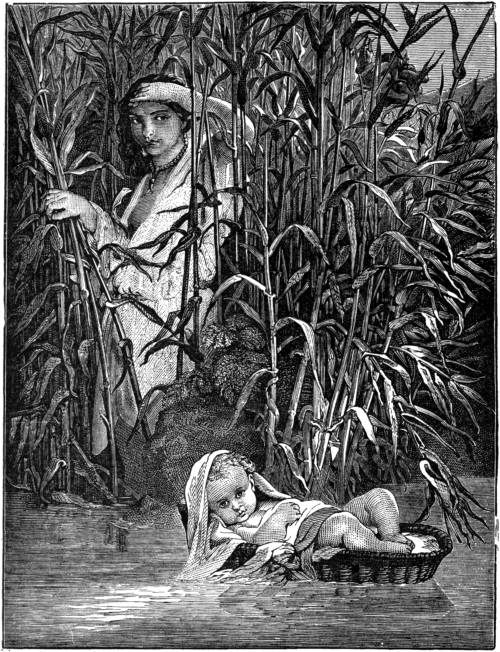
THE FINDING OF BABY MOSES.


Pharoah, becoming alarmed at the increasing power and numbers of the Israelites in Egypt, ordered that every male child who might be born to them should be cast into the river, and drowned. But the wife of a man named Levi felt that she could not give up her babe, and for three months she hid him. When she could hide him no longer, she prepared a basket of rushes, and coated it with pitch, so that it would float upon the river and keep out the water. In this ark she placed her infant son, and hid the ark among the flags and bulrushes on the river-bank, and set the child's sister to watch it.
Now it happened that the daughter of Pharaoh came with her maidens to bathe in the river; and when she saw the basket she sent one of her maids to fetch it. And when she looked at the child he wept, and she had compassion for him, and said, "This is one of the Hebrews' children." Then the child's sister came forward and said to Pharaoh's daughter, "Shall I call to thee a Hebrew woman that she may nurse the child for thee?" And when the princess said, "Go!" she, the maid, went and called her own mother, to whom Pharaoh's daughter said, "Take this child and nurse him for me, and I will give thee thy wages." And the woman took the child and nursed him. And when he had grown, his mother took him to the princess, who adopted him as her son, and called his name Moses, which means drawn out, because she took him from the water. Afterwards he grew to be a great man: he was learned in all the wisdom of the Egyptians; and we are told, "he was mighty in words and deeds."


THE FINDING OF MOSES.


The Kids Bible Story of Moses and the Passage of the Jordan


The Kids Bible Story of

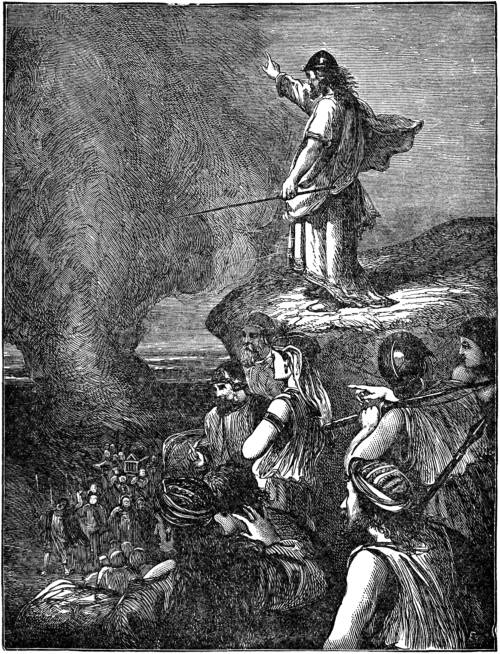
MOSES AND THE PASSAGE OF THE JORDAN.


Having wandered for forty years in the wilderness, the Israelites drew near to the river Jordan, at a place opposite Jericho. Moses was dead, and Joshua was now the leader of the host. God told him that the time had come when the people of Israel were to enter Canaan; to which land they had all this long time been travelling, but which previously they had not been permitted to enter on account of their sin. A description of this sin is given in the Bible, in the fourteenth chapter of Numbers.
But the people were now to cross the Jordan and enter Canaan. They were a very great multitude, and the river lay before them. How were they to cross? God told them! He commanded Joshua that the priests were to take the ark of the covenant and to go before the people; who were to follow a short distance behind. Could the priests and the people walk across the deep water? No. But as soon as the priests reached the river, and their feet were dipped in the water, God divided the Jordan into two, leaving dry ground for the Israelites to cross upon.
The priests carried the ark into the middle of the bed of the river and then stood still, and all the people passed on before them. When all were over, the priests carrying the ark moved forward also, and the waters returned to their proper place again. But before they did so, Joshua commanded twelve men, one from each tribe, each to take a stone from the river's bed; and these stones were set up as a memorial of the marvellous manner in which God had brought the Israelites across the Jordan into Canaan.


CROSSING THE JORDAN.


KIds Bible Story of How Jericho Was Captured


The Kid's Bible Story of

HOW JERICHO WAS CAPTURED.


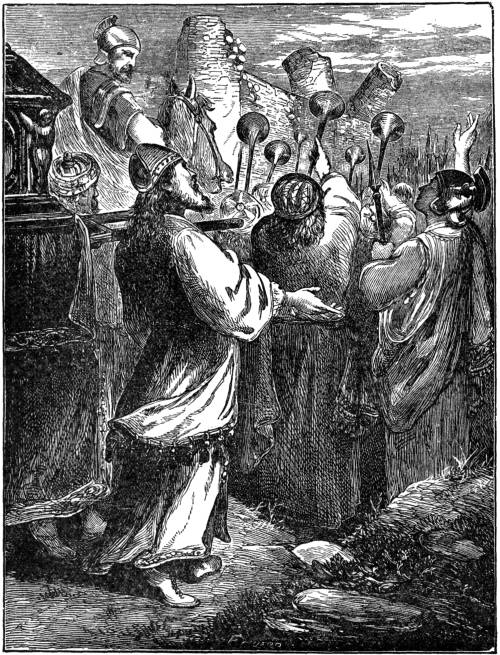
When men in olden times attacked a city, they tried to batter down the walls with heavy beams of wood, having heads of iron, called battering rams; but God did not instruct the Israelites thus to capture Jericho. They were to remember that it was not by their own power they could conquer the Canaanites, but only as God gave them the victory over their enemies. So God commanded Joshua to lay siege to Jericho in a very strange way. He said that seven priests, each having a trumpet, were to go before the ark. In front of them the armed men of Israel were to march; and behind the ark the people were to follow. In this way they were to go round the city once each day for six days, the priests blowing their trumpets each time. The seventh day they were to go in the same manner round the city seven times; and God said that when the priests blew their trumpets the seventh time, the people were to give a great shout, and the walls of the city would fall down.
Joshua and the people did as God commanded. They marched round the city carrying the ark, the priests blowing their trumpets; and on the seventh day they marched round seven times. The last time, when the priests blew their trumpets, the people shouted with a great shout, and the walls of the city fell down flat. Then the Israelites went up and took possession of it.
Thus God delivered Jericho into the hands of His people. All the inhabitants were killed except Rahab and her relatives. These were spared because Rahab had been kind to the spies whom Joshua had sent.


THE FALL OF JERICHO.


Kids Bible Story of Achan's Sin


Kids Bible Story of

ACHAN'S SIN.


God commanded the Israelites to destroy Jericho; and all the gold, silver, and other riches found there were to be devoted to the Lord. If any disobeyed this command then a curse was to rest upon all, and they were not to prosper.
The Israelites were to conquer the Canaanites, and drive them out of the land. So Joshua prepared to attack a city named Ai. Three thousand of his men went to capture it, but the inhabitants came out and drove them back, killing some of them. Joshua was greatly grieved. He knew that unless God made the Israelites victorious, the Canaanites would be able to overcome them, and God had appeared to fail them this time. Oh! he was sorry. But he told God the trouble, and God showed him the cause of it.
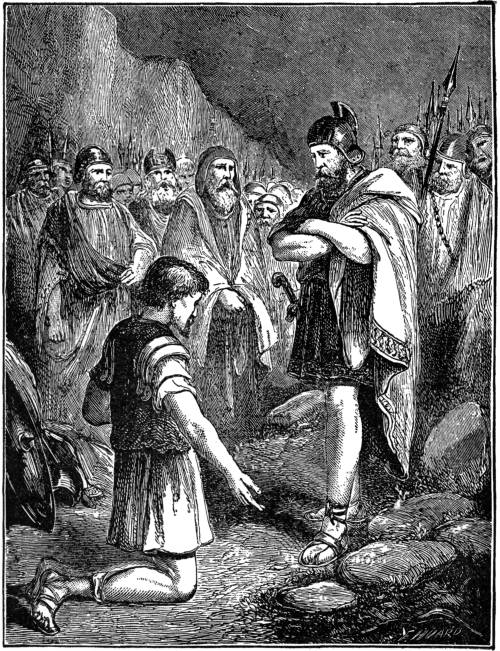
One of the Israelites, named Achan, saw among the spoil of Jericho, a handsome garment, some silver, and a bar of gold, and coveted them. He stole these things and hid them away in his tent, thinking that no one saw him; but God knew it all. Achan's sin was the cause of Israel's defeat! God showed Joshua how the man who had done the wickedness was to be discovered. Each tribe was to be brought before God, then each family of the tribe He chose, then each household of the family taken, and lastly each man of the family chosen. Finally, Achan was pointed out by God. Joshua bade him confess what he had done, and he said that he had taken the Babylonish garment and the gold and silver.
Messengers were sent to his tent, who brought what Achan had hidden; and he, with his sons and daughters, his cattle, and all that he had, and the garment, silver, and gold, were taken to a valley near by, where the people stoned them, and burned them with fire; and then raised over all a great heap of stones, which remained as a memorial to warn others against sinning as Achan had done.


ACHAN CONFESSING HIS SIN.


Kids Bible Story of the Alter on Mount Ebal


KIDS BIBLE STORY OF THE ALTAR ON MOUNT EBAL.

THE ALTAR ON MOUNT EBAL.

Before Moses died he called the Israelites together, and urged them to faithfully serve God; also directing that when they entered Canaan, they were to build an altar of rough stones, covered with plaster, on Mount Ebal, and to write the words of God's law upon this altar. Then six of the tribes were to stand on Mount Gerizim, and six on Mount Ebal, and, in the hearing of all the people, the blessings for obedience and the cursings for disobedience were to be proclaimed.

Mounts Ebal and Gerizim are two rugged mountains that face each other in Samaria. When the Israelites advanced thus far, they remembered the words of Moses. Joshua built the altar as directed, on which he offered sacrifices to God, and wrote a copy of the law upon it. All Israel stood, "half of them over against Mount Gerizim, and half of them over against Mount Ebal," and Joshua read all the words of the law, "the blessings and cursings, according to all that is written in the book of the law." Then the loud voices of the Levites were heard from the mountain sides, declaring, in the hearing of all the people, the blessings for obedience and the curses for disobedience, as God had commanded.


Kids Bible Story of God's Cities of Refuge


THE CITIES OF REFUGE

                                             FLEEING TO THE CITY OF REFUGE.

Revenge is contrary to the teaching of Jesus Christ, "If thine enemy hunger, feed him," says the Saviour; but among the Israelites and other eastern nations a different practice prevailed. If one slew another, the kinsman of him that was slain felt bound to avenge his relative, and to slay him that had done the deed. Sometimes people were killed by accident, when it was clearly unjust that he who had unwittingly killed another should be slain. To guard against the innocent thus suffering, God commanded that "cities of refuge" should be appointed, to which the slayer might flee, "which killeth any person at unawares."
These cities were six in number: Kedesh, Shechem, and Kirjath-arba, on the west of Jordan; and Bezer, Ramoth, and Golan, on the east of that river. They were so arranged that a few hours' rapid flight would bring the slayer from any part of the land to one of the cities of refuge. Jewish writers say that the roads leading to these cities were always kept in good repair, and that guide-posts were placed at every cross road with "Refuge! Refuge!" written upon them. But the man that wilfully killed another was not sheltered. He was given up to the avenger to be slain.
In our picture we see the slayer running to the city gate; the avenger close behind, shooting arrows at him. He has thus far escaped, and two or three more steps will place him in safety. But, once within the city, he must not quit its refuge until the death of the high priest. If he do so and the avenger find him he may be slain. But upon the death of the high priest he will be allowed to return home, to dwell in peace again.


Kids Bible Story of Joshua's Exhortation


KIDS BIBLE STORY OF JOSHUA'S EXHORTATION.


                                           JOSHUA EXHORTING THE PEOPLE.

Exhortation seems a hard word, but it simply means to strongly urge to good deeds, and this is what our artist shows Joshua to be doing.
Joshua is now an old man, and the Israelites are settled peaceably in Canaan. He has called them before him, with their elders, and heads, and judges, and officers. He tells them that he is old and about to die, and reminds them of the land that has already been conquered and divided among them, and of that which still remains to be conquered; urging them to be "very courageous to keep and to do all that is written in the book of the law of Moses, that they turn not aside therefrom to the right hand or to the left." He bids them take good heed therefore unto themselves, that they love the Lord their God; and warns them that if they go back and do wickedly, the anger of the Lord will be kindled against them, and they will perish quickly from off the good land which God has given them.
In his address, Joshua said, "Ye know in all your hearts and in all your souls, that not one good thing hath failed of all the good things which the Lord your God spake concerning you; all are come to pass unto you, and not one thing hath failed thereof." How faithful is God! He never fails in His promises: and we are told He is unchangeable, so that whatever He promises now He will fulfil, and whatever warnings He gives will surely come to pass. How good is it to have this holy and wise God for our Father, and to know that He promises abundantly to bless all those that trust in the Saviour, Jesus Christ. But let us take heed of the warnings against sin given in God's Holy Word.


Kids Bible Story of Gideon and the Defeat of the Midianites


THE KIDS BIBLE STORY OF GIDEON AND  DEFEAT OF THE MIDIANITES.ToC


Large numbers of the Israelites gathered around Gideon, prepared to fight against the Midianites, who were encamped in a valley, "like grasshoppers for multitude." How Gideon's host was reduced till only three hundred men remained, and the wonderful dream he heard related, when he and his servant went down as spies into the enemy's camp, are recorded in the seventh chapter of Judges. It was not by their own bravery or power that the Israelites were to overcome their enemies. God was to give them the victory: and He chose Gideon and three hundred men to overcome the great and mighty host of the Midianites.
Gideon divided his three hundred men into three companies, and put a trumpet in every man's hand, and gave to each a pitcher with a lamp inside. Then he said, "Look on me, and do likewise: when I blow with a trumpet, I and all that are with me, then blow ye the trumpets also on every side of the camp, and say, 'The sword of the Lord and of Gideon.'" Gideon and the hundred men of his company approached the enemy's camp by night, and the other two companies drew nigh also, so that the Midianites where surrounded. Then all blew their trumpets, broke their pitchers, held up their lamps (torches), and cried out as they had been commanded.
The Midianites heard the trumpets' blast and the cry, and saw the lights. They were thrown into confusion, and one fought against another; then they fled, and were pursued by the Israelites, great numbers of whom gathered together and followed after their flying enemies. Thus the Midianites were overcome, and Israel had peace during the lifetime of Gideon.
THE SWORD OF THE LORD, AND OF GIDEON

Kids Bible Story of the Death of Samson


THE DEATH OF SAMSON


Samson's birth was foretold by an angel. He was to grow up a Nazarite, forbidden to drink strong drink, neither was his head to be shaved. His strength was very great; but his marriage was sinful, and his doings with the idolatrous Philistines terrible. Though an Israelite and a judge, I fear much he sinned greatly against God. On one occasion he went to Gaza, a city of the Philistines. The inhabitants tried to take him, but he arose at midnight and carried away the gates of their city. In our picture though he looks so strong, yet we see chains on his legs, and he is blind! How came he to lose his sight and be made a prisoner? I think it was owing to his sin and folly.
He became acquainted with a wicked woman, who enticed him to tell her in what his great strength lay. Three times he told her falsely, but at last he said that if the flowing locks of his hair were removed his strength would depart. While he slept these locks were cut off, then the Philistines burst in upon him, and when he arose to resist them, he found that his strength was gone. Then his eyes were cruelly put out, and he was bound with fetters of brass.
Our artist shows him blind, brought out to make sport at the Philistines' feast. He is very sorrowful, and, I think, angry. He asks the lad beside him to place his hands upon the pillars supporting the house; then, his great strength returning, he bows himself with all his might; the pillars break, the house falls, and Samson, with very many of the Philistines, is crushed amid the ruins. Was not this a terrible end to what might have been a noble life?


SAMSON MAKING SPORT FOR THE PHILISTINES.


Kids Bible Story of Ruth and Naomi


KIDS BIBLE STORY OF RUTH AND NAOMI.ToC


Naomi was the wife of a Jew named Elimelech, who left his own city of Bethlehem to go into the land of Moab, because there was a famine in Canaan. Some time afterwards he died, leaving Naomi a widow with two sons, all dwellers in a strange land. Her sons married two young women belonging to Moab, whose names were Orpah and Ruth. After living there about ten years Naomi's sons died also, leaving Orpah and Ruth widows, along with their widowed mother-in-law. Then Naomi determined to return to her own land. Orpah and Ruth accompanied Naomi some distance on her journey; then she bade them to leave her, telling each to go back to her mother's house in Moab, while she would pursue her way alone to the land of Judah. They were unwilling to do so, saying they would go with her to her land and people; but she urged them to depart, assuring them that they would gain nothing by leaving their own country to accompany her, and that they had better return to their own homes. Then the story informs us—you will find it in the Bible, in the Book of Ruth—that Orpah kissed her mother-in-law and departed; but Ruth clave unto her, saying, "Whither thou goest, I will go; and where thou lodgest, I will lodge; thy people shall be my people, and thy God my God; where thou diest, will I die, and there will I be buried: the Lord do so to me and more also, if ought but death part thee and me."
So Ruth refused to leave her mother-in-law, and journeyed with her until they reached Canaan. Then they both dwelt in the city of Bethlehem, in the land of Judah, where we shall meet with them again.


RUTH AND NAOMI.

Kids Bible Story of Hannah Praying Before the Lord


HANNAH PRAYING BEFORE THE LORD.ToC


The Tabernacle, which had been set up by the Israelites in the wilderness, was after the conquest of Canaan erected at Shiloh, a city about ten miles south of Shechem. There it remained for more than three hundred years. No Temple was at Jerusalem in those days, so the Jewish priests offered sacrifices to God in the Tabernacle at Shiloh.
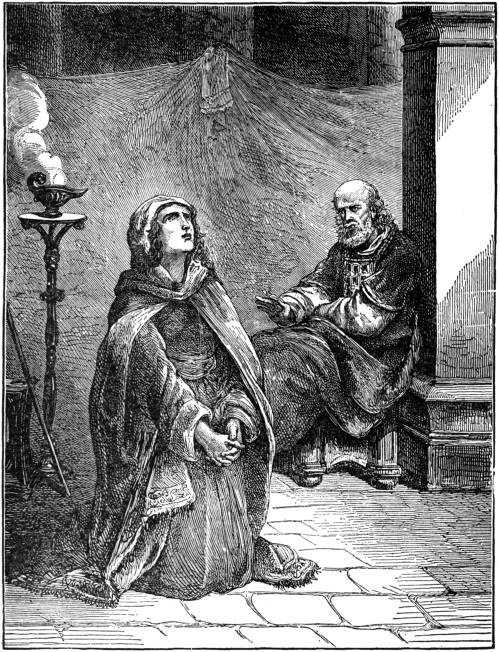
One day, Hannah, the wife of a priest named Elkanah, came to the Tabernacle to worship. She was grieved because she had no children; and especially sad because she had no son. So she knelt down and prayed to God, and asked God to remember her sorrow and to give her a son; promising that if God granted her request, she would give that son to Him all the days of his life.
As Hannah prayed, Eli, the high priest, saw her. She did not speak aloud, but prayed in her heart; her lips moved, but no voice was heard; so Eli thought that a drunken woman had come before the Lord. He reproved her saying, "How long wilt thou be drunken? Put away thy wine from thee." But Hannah had not drunk wine. She answered Eli, "No, my lord, I am a woman of a sorrowful spirit. I have drunk neither wine nor strong drink, but have poured out my soul before the Lord." Then Eli bade her "Go in peace, and the God of Israel grant thee thy petition that thou hast asked of Him."
Hannah left the Tabernacle. Her face was no longer sad. She believed God had heard her prayer; and He had done so. In due time a son was given her, whom she named Samuel. Samuel means Heard of God, which name Hannah gave him in remembrance of God's goodness in hearing her prayer.


HANNAH PRAYING BEFORE THE LORD.


Sunday, June 17, 2012

The Kid's Bible Story of the Ladder That Reached to Heaven


THE KID'S BIBLE STORY OF THE LADDER THAT REACHED TO HEAVEN

After Esau found that he had lost his birthright and his blessing, he was very angry against his brother Jacob; and he said to himself, and told others:
"My father Isaac is very old and cannot live long. As soon as he is dead, then I shall kill Jacob for having robbed me of my right."
When Rebekah heard this, she said to Jacob, "Before it is too late, do you go away from home and get out of Esau's sight. Perhaps when Esau sees you no longer, he will forget his anger, and then you can come home again. Go and visit my brother Laban, your uncle, in Haran, and stay with him for a little while."
We must remember that Rebekah came from the family of Nahor, Abraham's younger brother, who lived in Haran, a long distance to the northeast of Canaan, and that Laban was Rebekah's brother.
So Jacob went out of Beersheba, on the border of the desert, and walked alone, carrying his staff in his hand. One evening, just about sunset, he came to a place among the mountains, more than sixty miles distant from his home. And as he had no bed to lie down upon, he took a stone and rested his head upon it for a pillow, and lay down to sleep.
Angels were upon the stairs
And on that night Jacob had a wonderful dream. In his dream he saw stairs leading from the earth where he lay up to heaven; and angels were going up and coming down upon the stairs. And above the stairs, he saw the Lord God standing. And God said to Jacob:
"I am the Lord, the God of Abraham, and the God of Isaac your father; and I will be your God, too. The land where you are lying all alone, shall belong to you and to your children after you; and your children shall spread abroad over the lands, east and west, and north and south, like the dust of the earth; and in your family all the world shall receive a blessing. And I am with you in your journey, and I will keep you where you are going, and will bring you back to this land. I will never leave you, and I will surely keep my promise to you."
And in the morning Jacob awakened from his sleep, and he said:
"Surely, the Lord is in this place, and I did not know it! I thought that I was all alone, but God has been with me. This place is the house of God; it is the gate of heaven!"
And Jacob took the stone on which his head had rested, and he set it up as a pillar, and poured oil on it as an offering to God. And Jacob named that place Bethel, which in the language that Jacob spoke means "The House of God."
And Jacob made a promise to God at that time, and said:
"If God really will go with me and will keep me in the way that I go, and will give me bread to eat and will bring me to my father's house in peace, then the Lord shall be my God: and this stone shall be the house of God, and of all that God gives me I will give back to God one-tenth as an offering."
Then Jacob went onward in his long journey. He walked across the river Jordan in a shallow place, feeling his way with his staff; he climbed mountains and journeyed beside the great desert on the east, and at last came to the city of Haran. Beside the city was the well, where Abraham's servant had met Jacob's mother, Rebekah; and there, after Jacob had waited for a time, he saw a young woman coming with her sheep to give them water.
Then Jacob took off the flat stone that was over the mouth of the well, and drew water and gave it to the sheep. And when he found that this young woman was his own cousin Rachel, the daughter of Laban, he was so glad that he wept for joy. And at that moment he began to love Rachel, and longed to have her for his wife.
Jacob went onward in his long journey 
Jacob went onward in his long journey
Rachel's father, Laban, who was Jacob's uncle, gave a welcome to Jacob, and took him into his home.
And Jacob asked Laban if he would give his daughter, Rachel, to him as his wife; and Jacob said, "If you give me Rachel, I will work for you seven years."
And Laban said, "It is better that you should have her, than that a stranger should marry her."
So Jacob lived seven years in Laban's house, caring for his sheep and oxen and camels; but his love for Rachel made the time seem short.
At last the day came for the marriage; and they brought in the bride, who, after the manner of that land, was covered with a thick veil, so that her face could not be seen. And she was married to Jacob, and when Jacob lifted up her veil he found that he had married, not Rachel, but her older sister, Leah, who was not beautiful, and whom Jacob did not love at all.
Jacob was very angry that he had been deceived,—though that was just the way in which Jacob himself had deceived his father and cheated his brother Esau. But his uncle Laban said:
"In our land we never allow the younger daughter to be married before the older daughter. Keep Leah for your wife, and work for me seven years longer, and you shall have Rachel also."
For in those times, as we have seen, men often had two wives, or even more than two. So Jacob stayed seven years more, fourteen years in all, before he received Rachel as his wife.
While Jacob was living at Haran, eleven sons were born to him. But only one of these was the child of Rachel, whom Jacob loved. This son was Joseph, who was dearer to Jacob than any other of his children, partly because he was the youngest, and because he was the child of his beloved Rachel.

Saturday, June 2, 2012

KIds Bible Story of Joseph and the Story of the Money in the Sacks


KIDS BIBLE STORY OF JOSEPH AND THE STORY OF THE MONEY IN THE SACKS


When Joseph was made ruler over the land of Egypt, he did just as he had always done. It was not Joseph's way to sit down, to rest and enjoy himself, and make others wait on him. He found his work at once, and began to do it faithfully and thoroughly. He went out over all the land of Egypt, and saw how rich and abundant were the fields of grain, giving much more than the people could use for their own needs. He told the people not to waste it, but to save it for the coming time of need.
And he called upon the people to give him for the king one bushel of grain out of every five, to be stored up. The people brought their grain, after taking for themselves as much as they needed, and Joseph stored it up in great storehouses in the cities; so much at last that no one could keep account of it.
The king of Egypt gave a wife to Joseph from the noble young women of his kingdom. Her name was Asenath; and to Joseph and his wife God gave two sons. The oldest son he named Manasseh, a word which means "Making to Forget."
"For," said Joseph, "God has made me to forget all my troubles and my toil as a slave."
The second son he named Ephraim, a word that means "Fruitful." "Because," said Joseph, "God has not only made the land fruitful; but he has made me fruitful in the land of my troubles."
The seven years of plenty soon passed by, and then came the years of need. In all the lands around people were hungry, and there was no food for them to eat; but in the land of Egypt everybody had enough. Most of the people soon used up the grain that they had saved; many had saved none at all, and they all cried to the king to help them.
"Go to Joseph!" said king Pharaoh, "and do whatever he tells you to do."
Then the people came to Joseph, and Joseph opened the storehouses, and sold to the people all the grain that they wished to buy. And not only the people of Egypt came to buy grain, but people of all the lands around as well, for there was great need and famine everywhere. And the need was as great in the land of Canaan, where Jacob lived, as in other lands. Jacob was rich in flocks and cattle, and gold and silver, but his fields gave no grain, and there was danger that his family and his people would starve. And Jacob—who was now called Israel also—heard that there was food in Egypt and he said to his sons: "Why do you look at each other, asking what to do to find food? I have been told that there is grain in Egypt. Go down to that land, and take money with you, and bring grain, so that we may have bread, and may live."
Then the ten older brothers of Joseph went down to the land of Egypt. They rode upon asses, for horses were not much used in those times, and they brought money with them. But Jacob would not let Benjamin, Joseph's younger brother, go with them, for he was all the more dear to his father, now that Joseph was no longer with him; and Jacob feared that harm might come to him.
Then Joseph's brothers came to Joseph to buy food. They did not know him, grown up to be a man, dressed as a prince, and seated on a throne. Joseph was now nearly forty years old, and it had been almost twenty-three years since they had sold him. But Joseph knew them all, as soon as he saw them. He wished to be sharp and stern with them, not because he hated them; but because he wished to see what their spirit was, and whether they were as selfish, and cruel, and wicked as they had been in other days.
They came before him, and bowed, with their faces to the ground. Then, no doubt, Joseph thought of the dream that had come to him while he was a boy, of his brothers' sheaves bending down around his sheaf. He spoke to them as a stranger, as if he did not understand their language, and he had their words explained to him in the language of Egypt.
"Who are you? And from what place do you come?" said Joseph, in a harsh, stern manner.
They answered him very meekly: "We have come from the land of Canaan to buy food."
"No," said Joseph, "I know what you have come for. You have come as spies, to see how helpless the land is, so that you can bring an army against us, and make war on us."
"No, no," said Joseph's ten brothers. "We are no spies. We are the sons of one man, who lives in the land of Canaan; and we have come for food, because we have none at home."
"You say that you are the sons of one man, who is your father? Is he living? Have you any more brothers? Tell me all about yourselves."
And they said: "Our father is an old man in Canaan. We did have a younger brother, but he was lost; and we have one brother still, who is the youngest of all, but his father could not spare him to come with us."
"No," said Joseph. "You are not good, honest men. You are spies. I shall put you all in prison, except one of you; and he shall go and bring that youngest brother of yours; and when I see him, then I will believe that you tell the truth."
So Joseph put all the ten men in prison, and kept them under guard for three days; then he sent for them again. They did not know that he could understand their language, and they said to each other, while Joseph heard, but pretended not to hear: "This has come upon us because of the wrong that we did to our brother Joseph, more than twenty years ago. We heard him cry, and plead with us, when we threw him into the pit, and we would not have mercy on him. God is giving us only what we have deserved."
And Reuben, who had tried to save Joseph, said: "Did I not tell you not to harm the boy? and you would not listen to me. God is bringing our brother's blood upon us all."
When Joseph heard this, his heart was touched, for he saw that his brothers were really sorry for the wrong that they had done to him. He turned away from them, so that they could not see his face, and he wept. Then he turned again to them and spoke roughly as before, and said:
"This I will do, for I serve God. I will let you all go home, except one man. One of you I will shut up in prison; but the rest of you can go home and take food for your people. And you must come back and bring your youngest brother with you, and I shall know then that you have spoken the truth."
Then Joseph gave orders, and his servants seized one of his brothers, whose name was Simeon, and bound him in their sight and took him away to prison. And he ordered his servants to fill the men's sacks with grain, and to put every man's money back into the sack before it was tied up, so that they would find the money as soon as they opened the sack. Then the men loaded their asses with the sacks of grain, and started to go home, leaving their brother Simeon a prisoner.
When they stopped on the way to feed their asses, one of the brothers opened his sack, and there he found his money lying on the top of the grain. He called out to his brothers: "See, here is my money given again to me!" And they were frightened, but they did not dare to go back to Egypt and meet the stern ruler of the land. They went home and told their old father all that had happened to them, and how their brother Simeon was in prison, and must stay there until they should return, bringing Benjamin with them.
When they opened their sacks of grain, there in the mouth of each sack was the money that they had given; and they were filled with fear. Then they spoke of going again to Egypt and taking Benjamin, but Jacob said to them:
"You are taking my sons away from me. Joseph is gone, and Simeon is gone, and now you would take Benjamin away. All these things are against me!" Reuben said: "Here are my own two boys. You may kill them, if you wish, in case I do not bring Benjamin back to you." But Jacob said: "My youngest son shall not go with you. His brother is dead, and he alone is left to me. If harm should come to him, it would bring down my gray hairs with sorrow to the grave."

The Kids Bible Story of the Ladder that reached to Heaven


THE STORY OF THE LADDER THAT REACHED TO HEAVEN

After Esau found that he had lost his birthright and his blessing, he was very angry against his brother Jacob; and he said to himself, and told others:
"My father Isaac is very old and cannot live long. As soon as he is dead, then I shall kill Jacob for having robbed me of my right."
When Rebekah heard this, she said to Jacob, "Before it is too late, do you go away from home and get out of Esau's sight. Perhaps when Esau sees you no longer, he will forget his anger, and then you can come home again. Go and visit my brother Laban, your uncle, in Haran, and stay with him for a little while."
We must remember that Rebekah came from the family of Nahor, Abraham's younger brother, who lived in Haran, a long distance to the northeast of Canaan, and that Laban was Rebekah's brother.
So Jacob went out of Beersheba, on the border of the desert, and walked alone, carrying his staff in his hand. One evening, just about sunset, he came to a place among the mountains, more than sixty miles distant from his home. And as he had no bed to lie down upon, he took a stone and rested his head upon it for a pillow, and lay down to sleep.
Angels were upon the stairs
And on that night Jacob had a wonderful dream. In his dream he saw stairs leading from the earth where he lay up to heaven; and angels were going up and coming down upon the stairs. And above the stairs, he saw the Lord God standing. And God said to Jacob:
"I am the Lord, the God of Abraham, and the God of Isaac your father; and I will be your God, too. The land where you are lying all alone, shall belong to you and to your children after you; and your children shall spread abroad over the lands, east and west, and north and south, like the dust of the earth; and in your family all the world shall receive a blessing. And I am with you in your journey, and I will keep you where you are going, and will bring you back to this land. I will never leave you, and I will surely keep my promise to you."
And in the morning Jacob awakened from his sleep, and he said:
"Surely, the Lord is in this place, and I did not know it! I thought that I was all alone, but God has been with me. This place is the house of God; it is the gate of heaven!"
And Jacob took the stone on which his head had rested, and he set it up as a pillar, and poured oil on it as an offering to God. And Jacob named that place Bethel, which in the language that Jacob spoke means "The House of God."
And Jacob made a promise to God at that time, and said:
"If God really will go with me and will keep me in the way that I go, and will give me bread to eat and will bring me to my father's house in peace, then the Lord shall be my God: and this stone shall be the house of God, and of all that God gives me I will give back to God one-tenth as an offering."
Then Jacob went onward in his long journey. He walked across the river Jordan in a shallow place, feeling his way with his staff; he climbed mountains and journeyed beside the great desert on the east, and at last came to the city of Haran. Beside the city was the well, where Abraham's servant had met Jacob's mother, Rebekah; and there, after Jacob had waited for a time, he saw a young woman coming with her sheep to give them water.
Then Jacob took off the flat stone that was over the mouth of the well, and drew water and gave it to the sheep. And when he found that this young woman was his own cousin Rachel, the daughter of Laban, he was so glad that he wept for joy. And at that moment he began to love Rachel, and longed to have her for his wife.
Jacob went onward in his long journey 
Jacob went onward in his long journey
Rachel's father, Laban, who was Jacob's uncle, gave a welcome to Jacob, and took him into his home.
And Jacob asked Laban if he would give his daughter, Rachel, to him as his wife; and Jacob said, "If you give me Rachel, I will work for you seven years."
And Laban said, "It is better that you should have her, than that a stranger should marry her."
So Jacob lived seven years in Laban's house, caring for his sheep and oxen and camels; but his love for Rachel made the time seem short.
At last the day came for the marriage; and they brought in the bride, who, after the manner of that land, was covered with a thick veil, so that her face could not be seen. And she was married to Jacob, and when Jacob lifted up her veil he found that he had married, not Rachel, but her older sister, Leah, who was not beautiful, and whom Jacob did not love at all.
Jacob was very angry that he had been deceived,—though that was just the way in which Jacob himself had deceived his father and cheated his brother Esau. But his uncle Laban said:
"In our land we never allow the younger daughter to be married before the older daughter. Keep Leah for your wife, and work for me seven years longer, and you shall have Rachel also."
For in those times, as we have seen, men often had two wives, or even more than two. So Jacob stayed seven years more, fourteen years in all, before he received Rachel as his wife.
While Jacob was living at Haran, eleven sons were born to him. But only one of these was the child of Rachel, whom Jacob loved. This son was Joseph, who was dearer to Jacob than any other of his children, partly because he was the youngest, and because he was the child of his beloved Rachel.